

OADM Mux&Demux
Overview
OADM (Optical Add-Drop Multiplexer)
OADM is a critical component in optical fiber communication networks, enabling the addition and dropping of specific wavelength channels from a multi-wavelength optical signal (WDM, Wavelength Division Multiplexing) without disrupting other channels. It plays a key role in constructing flexible, scalable optical networks.
Unlike Mux/Demux (which process all wavelengths), OADM adds/drops specific wavelengths without disrupting others, enabling efficient traffic scheduling in MANs and access networks.
- Avoids full wavelength demultiplexing and optical-electrical-optical conversion, reducing equipment cost and power consumption compared to OXC and fixed WDM systems.
- ROADM (reconfigurable OADM) supports dynamic wavelength configuration, adapting to traffic changes without network downtime (superior to fixed-function devices like FWC).
- Smaller form factor and lower power consumption than OXC, making it suitable for distributed nodes (e.g., 5G base stations, suburban optical cabinets).
- Enables wavelength-level protection switching (e.g., 1+1 redundancy), while optical amplifiers (OA) only enhance signal strength without routing resilience.
- OADM’s core advantage lies in its ability to balance flexibility, cost-effectiveness, and reliability for mid-range optical network nodes, bridging the gap between simple Mux/Demux and complex OXC systems.
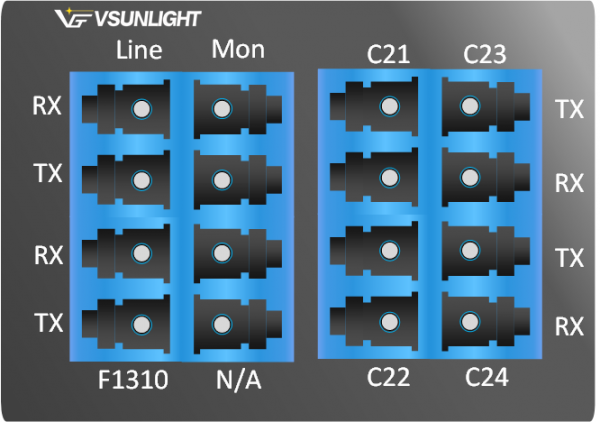
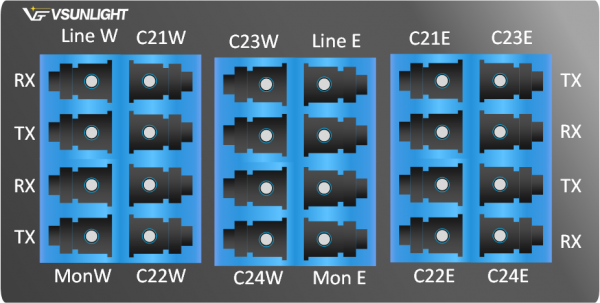
Product Display

 +86-760-22288503
  sales@vsunlight.net
 Building C,NO.2 Qinye Road,Torch Development Zone,Zhong Shan City, Guangdong, PRC.
+86-760-22288503
sales@vsunlight.net
Building C,NO.2 Qinye Road,Torch Development Zone,Zhong Shan City, Guangdong, PRC.

点击右上角
分享给朋友吧
Copyright © 2026 Vsunlight Optical Technology Inc. All Rights Reserved.
